Want to Become a Full-Stack Developer? Start With These 5 Courses

Discover the best full-stack web developer courses for beginners in 2026, including free and paid options, practical projects, and career tips.
Learning full-stack web development can feel overwhelming at the beginning.
One course teaches only HTML and CSS. Another jumps directly into React, APIs, databases, and cloud deployment.
Meanwhile, YouTube is full of “become a developer in 30 days” videos that make everything look unrealistically easy.
The truth is that becoming a full-stack developer takes time because you are learning both front-end and back-end development together.
However, the right course can make the learning process much less confusing, especially if you focus on practical projects instead of only theory.
Another important thing to understand is that certificates alone rarely get people hired anymore.
Companies usually care much more about your portfolio projects, practical skills, GitHub activity and problem-solving ability.
That’s why the best web development courses today are the ones that help you actually build things while learning.
In this guide, we’ll cover some of the best full-stack web developer courses for beginners, including both free and paid options, what each course is best for, and who should avoid certain learning paths.
1. IBM Full Stack Software Developer Professional Certificate (Coursera)
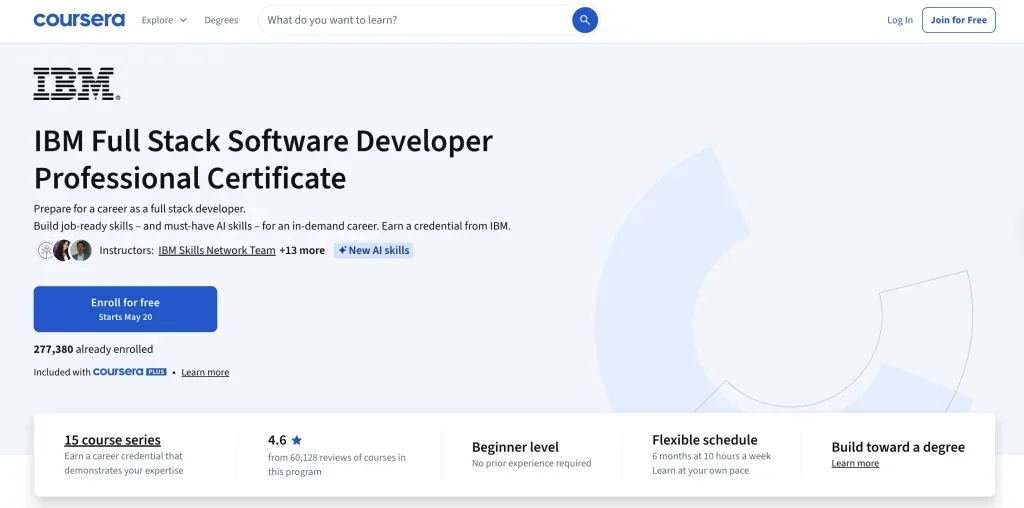
Rate: 4.5 ⭐
Length: 4 months (10 hours per week)
Price: Free
Level: Beginner
The IBM Professional Certificate is still one of the strongest beginner-friendly paths for people who want a more structured introduction to full-stack web development.
Unlike many fast-paced coding courses, this one starts slowly and explains concepts clearly, which helps beginners who feel completely lost at the start.
The course covers:
- HTML and CSS
- JavaScript
- React
- Node.js
- Python
- cloud development
- APIs
- GitHub
- Docker basics
One thing that makes this course valuable is the amount of hands-on work included. Instead of only watching tutorials, students build portfolio projects throughout the program.
This course is especially useful for:
- complete beginners
- career changers
- people who prefer step-by-step learning
However, it is not the fastest option. Some learners may find parts of the program slightly slower compared to modern bootcamp-style courses.
2. The Web Developer Bootcamp 2026 (Udemy)
Rate: 4.7 ⭐
Length: Around 74 hours
Price: Paid (often discounted on Udemy)
Level: Beginner to Intermediate
This is one of the most popular web developer bootcamps online for a reason.
Instead of overwhelming beginners immediately with advanced frameworks, the course starts with the fundamentals and gradually becomes more complex. It covers:
- HTML
- CSS
- JavaScript
- Node.js
- Express
- MongoDB
- APIs
- authentication
- deployment
The strongest part of this course is the teaching style. The explanations feel practical instead of overly academic, which helps beginners stay motivated longer.
This course is best for people who:
- learn by building projects
- want a long-term roadmap
- prefer practical exercises over theory
One important thing to know is that web development changes constantly. Some smaller sections may eventually feel outdated over time, but the overall learning structure remains very valuable for beginners.
3. Full Stack Open (University of Helsinki)
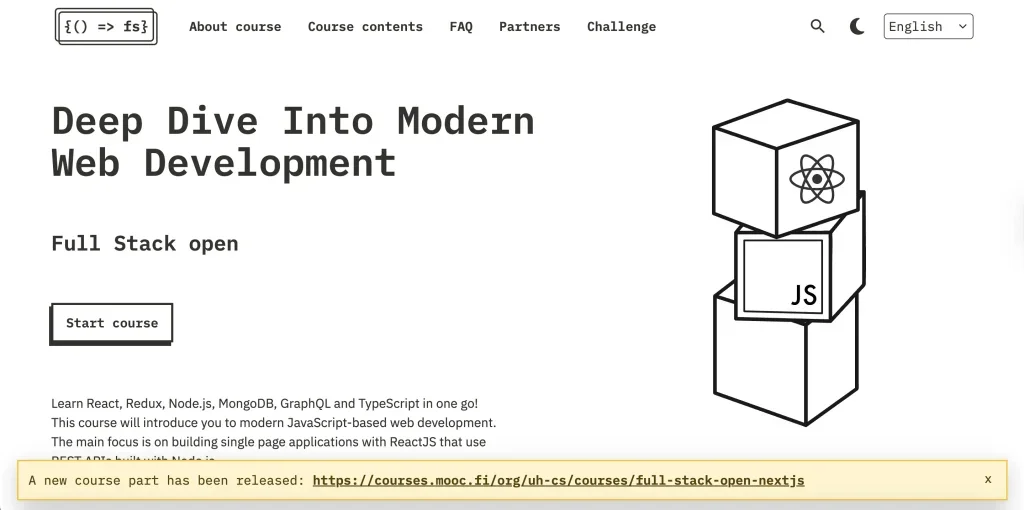
Rate: Highly rated by developers worldwide
Length: Self-paced
Price: Free
Level: Intermediate Beginner
This course is completely free and much more modern than many traditional coding tutorials.
However, it is also more difficult.
Full Stack Open focuses heavily on modern JavaScript development using:
- React
- Node.js
- GraphQL
- MongoDB
- TypeScript
- testing
- APIs
The course is project-heavy and feels closer to real developer work compared to many beginner tutorials online.
Because of that, it is usually better for:
- people who already understand basic HTML/CSS/JavaScript
- self-learners
- motivated beginners willing to struggle through harder concepts
This is NOT the easiest beginner course. Some people quit early because the pace becomes challenging quickly.
But for learners who stay consistent, it can become one of the strongest portfolio-building resources available online.
4. Meta Front-End + Back-End Developer Programs (Coursera)
Rate: 4.7 ⭐
Length: Several months combined
Price: Subscription-based
Level: Beginner
Meta’s developer programs became very popular because they focus heavily on practical development skills connected to real-world applications.
The programs teach:
- React
- JavaScript
- databases
- APIs
- version control
- responsive design
- back-end fundamentals
One useful thing about these courses is that they help beginners understand how modern developer teams actually work together.
The learning style feels cleaner and more modern than many older programming courses.
This path is especially useful for people interested in:
- remote developer jobs
- frontend-heavy full-stack work
- portfolio building
- collaborative workflows
However, like most certificates, completing the course alone will not guarantee a developer job. Portfolio projects and practical experience still matter much more during hiring.
5. Become Full Stack Developer (Great Learning)
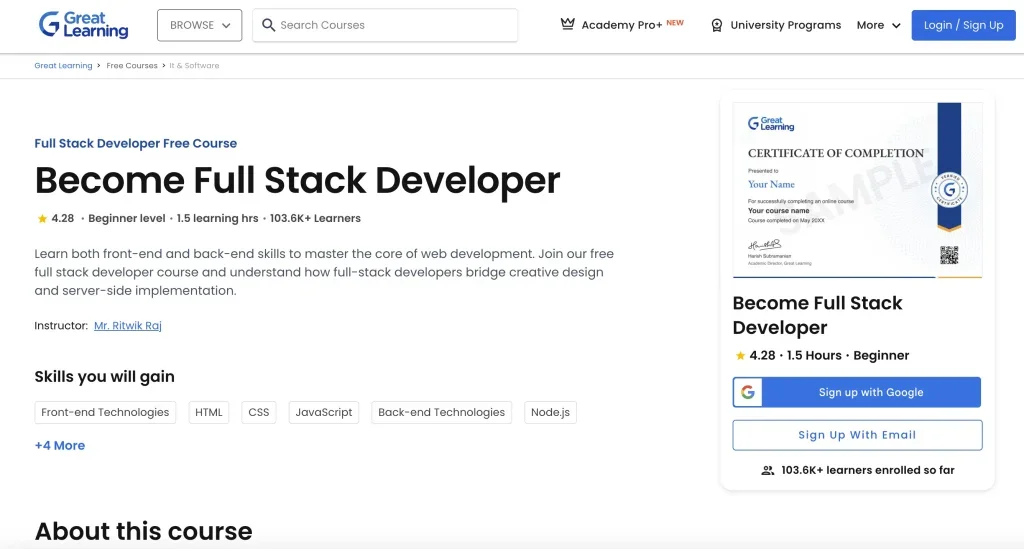
Rate: 4.25 ⭐
Length: 1 hour
Price: Free
Level: Beginner
This is not a complete developer bootcamp like the other courses above.
Instead, it works better as a short introduction for people who still do not fully understand what a full-stack developer actually does.
The course explains:
- what front-end and back-end development mean
- which technologies developers use
- what learning roadmap beginners can follow
- what skills are most important today
Because the course is short and beginner-friendly, it works well for people who:
- feel overwhelmed by programming
- want a simple overview first
- are deciding whether web development is the right career path
It will not make someone job-ready on its own, but it can help beginners understand the bigger picture before investing months into coding courses.
Conclusion
Learning full-stack web development is not a quick process, and no course will instantly turn someone into a professional developer.
However, the right learning path can save months of confusion and help beginners focus on practical skills instead of endlessly watching tutorials.
If you are completely new, beginner-friendly courses like IBM or Meta are usually safer starting points.
More advanced learners who already know JavaScript basics may benefit more from project-heavy programs like Full Stack Open.
The most important thing is not choosing the “perfect” course.
It’s consistently building projects, practising your skills, and staying patient long enough to improve.